Countermarked Coins as Evidence of Emergency Monetary Intervention
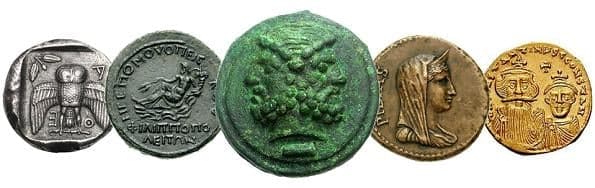
Sometimes a government doesn't have time to make new money. So it takes the money already in circulation and stamps its authority onto it.
Imagine a monetary system under pressure.
A war has started.
A new ruler has taken power.
The treasury is short of bullion.
A foreign currency is flooding local markets.
Or a government suddenly needs to make thousands of existing coins acceptable for a new purpose.
Normally, the obvious solution would be to mint new coins.
But minting takes time.
You need metal.
You need dies.
You need workshops.
You need workers.
You need distribution.
And, most importantly, you need the administrative machinery to actually get the new money where it needs to go.
Sometimes a government doesn't have the luxury of waiting.
So it does something much stranger.
It takes coins that already exist and marks them.
A small punch.
A symbol.
A letter.
A portrait.
A countermark.
The original coin remains visible underneath.
The new authority has simply added something to it.
At first glance, this looks like an insignificant alteration to an old piece of metal.
It isn't.
A countermark can represent one of the most interesting moments in monetary history:
the moment when an authority intervenes in a monetary system that already exists.
But here's the methodological trap.
A countermark does not automatically mean:
"Emergency!"
It may have been used for authentication, revaluation, territorial control, military payments, taxation, or other administrative purposes.
So the real question is much more interesting:
When can countermarked coins be used as evidence of emergency monetary intervention?
To answer that, we need to understand what the countermark actually changed.
The coin was already there
This is the crucial difference.
A newly minted coin represents the creation of money.
A countermarked coin represents the modification of existing money.
That distinction tells us something about the monetary environment.
The authority did not necessarily need to create a completely new object.
It needed to make an existing object acceptable for some new or altered purpose.
That could be extraordinarily useful during periods of disruption.
Imagine thousands of foreign coins already circulating in a region.
Merchants know them.
People recognize their weight.
Markets accept them.
Then a new political authority arrives.
Instead of withdrawing every foreign coin and replacing it, the authority could mark selected coins.
Suddenly, the old money carries a new official signal.
The monetary system has been modified without starting from zero.
That's an extremely efficient administrative trick.
But why intervene at all?
There are several possibilities.
Authentication
The countermark might certify that a coin has been examined and accepted.
Revaluation
The authority might assign the coin a different value.
Territorial control
A local authority might mark coins to indicate that they are valid within its jurisdiction.
Tax or payment requirements
A countermark could identify coins accepted for specific official transactions.
Military use
Armies operating far from a central mint could need a practical way to validate or adapt existing currency.
Emergency monetary management
A sudden shortage of acceptable money might require authorities to intervene quickly.
These explanations can overlap.
And that is why the countermark itself is only the beginning of the investigation.
The emergency hypothesis
Suppose you find a large number of foreign coins.
Then, within a narrow period, many of them receive the same countermark.
At roughly the same time, the region experiences political or economic disruption.
Now we have something interesting.
The countermark may represent an attempt to adapt an existing monetary stock to new conditions.
But we still need to ask:
Why countermark these coins rather than mint new ones?
That question is the heart of the emergency hypothesis.
Emergency monetary intervention is about constraints
An emergency is not simply "something bad happened."
From a monetary perspective, the important issue is constraint.
Perhaps the government lacks enough silver.
Perhaps the official mint cannot operate normally.
Perhaps the administration has expanded into a region where its own currency is scarce.
Perhaps a military campaign has created an immediate demand for spendable money.
Perhaps an existing currency is suddenly politically unacceptable unless officially validated.
Countermarking can solve some of these problems without requiring the complete replacement of circulating currency.
It is monetary improvisation.
And improvisation is often what governments do when normal systems are not functioning efficiently.
Think of it as a monetary patch
There is a useful modern analogy here.
Imagine a computer system that cannot be completely rebuilt immediately.
Instead, engineers deploy a patch.
The underlying system remains.
But an additional layer changes how it functions.
A countermark can work somewhat like that.
The original coin remains recognizable.
Its original issuer remains visible.
Its original design remains.
But the countermark changes its administrative status.
The government has effectively added a new instruction to an old monetary object.
Not elegant.
Not necessarily permanent.
But potentially very practical.
The composition of the countermarked group matters
Suppose every coin in the region gets countermarked.
That's one thing.
Suppose only foreign coins get countermarked.
That's another.
Suppose only older coins get marked.
Another.
Suppose only certain denominations are targeted.
Again, different story.
This is why the selection pattern matters as much as the mark itself.
If a countermark systematically targets coins that were already circulating but lacked official recognition, perhaps the government was trying to absorb them into its own monetary system.
If it targets worn coins, perhaps valuation or authentication mattered.
If it appears primarily on foreign money, perhaps the authority was managing an inherited or imported monetary stock.
The pattern gives the countermark context.
Foreign coins are especially revealing
Imagine a new political authority enters a region where the population already uses foreign currency.
The authority has a problem.
People already trust the foreign coins.
Merchants already know their weights.
Prices are already negotiated around them.
Simply declaring:
"Everyone stop using those coins. Here's our new currency."
would be expensive and disruptive.
Countermarking offers another possibility.
Take the coins people already have.
Add an official mark.
Allow them to continue circulating.
The state has effectively hijacked an existing monetary network rather than building a new one.
That's clever.
And it tells us something about the practical limits of political power.
The emergency may be visible in the timing
Chronology becomes critical again.
Suppose countermarking appears:
before a war
during a war
immediately after a conquest
during a succession crisis
or
during a documented monetary shortage.
The timing can dramatically change the interpretation.
A countermark introduced during a period of political stability might represent ordinary administrative regulation.
The same countermark appearing during a sudden military crisis deserves a different investigation.
The question is not simply:
"When did countermarking happen?"
It is:
"What else was happening when countermarking suddenly became necessary?"
A sudden burst is more interesting than a slow trickle
Imagine countermarked coins appear over 100 years.
That looks like an established institutional practice.
Now imagine almost none exist for decades, followed by thousands appearing within a few years.
That is much more interesting from an emergency perspective.
The sudden increase suggests a change in policy.
And policy changes require explanation.
Perhaps the monetary environment changed.
Perhaps political authority changed.
Perhaps the composition of circulating currency changed.
Perhaps an emergency occurred.
Again, we're generating hypotheses.
Not declaring conclusions.
Geographic concentration can reveal the scale of intervention
Now map the countermarked coins.
Suppose they cluster around a military frontier.
That could indicate military administration.
Suppose they cluster around a newly conquered province.
That could indicate monetary integration.
Suppose they cluster around a major port.
That could indicate the management of foreign currency entering the economy.
Suppose they appear throughout the entire political territory.
That suggests something more centralized.
Geography therefore helps answer:
Who needed the intervention, and where?
Countermarks can expose the boundaries of authority
Here's one of the coolest possibilities.
Imagine a countermark is common in Region A but almost absent in Region B.
And the two regions sit on opposite sides of a political boundary.
That may tell us something about where an authority's monetary policy actually reached.
The political map says:
the state controls both regions.
The coins might say:
its monetary administration didn't operate equally strongly in both.
That's a valuable distinction.
Political sovereignty and monetary control are not necessarily identical.
What if the countermark changes the denomination?
Now things get even more interesting.
Suppose a coin originally belonged to one monetary system.
A countermark effectively gives it a new value.
The state has not merely authenticated an object.
It has altered its position within the monetary hierarchy.
That is a direct monetary intervention.
The question becomes:
Why did the state need to change the value of existing coins?
Perhaps the old denomination no longer fit the new system.
Perhaps exchange rates changed.
Perhaps inflation or fiscal stress altered the monetary environment.
Perhaps foreign currency needed to be integrated into a domestic system.
This is where countermarks become evidence for studying monetary transitions.
The physical punch can tell us something too
Not all countermarks are created equally.
Their:
size,
depth,
placement,
orientation,
design,
and consistency
can provide information.
If a mark is standardized and carefully applied, perhaps a formal authority controlled the process.
If marks vary substantially, perhaps multiple local authorities or less standardized practices were involved.
If the original design is deliberately struck over a specific area, perhaps the countermark was intended to override or complement a particular feature.
Even the physical act of marking can contain administrative information.
The coin is a document.
The countermark is an amendment.
But here's the problem with the emergency theory
Governments don't only improvise during emergencies.
They also regulate money during perfectly ordinary periods.
A countermark could be routine.
It could certify weight.
It could indicate taxation.
It could establish local acceptability.
It could be part of a standardized administrative system that lasted generations.
So we need evidence that something actually changed.
The strongest emergency cases should therefore show some combination of:
abrupt appearance,
high concentration,
narrow chronology,
unusual target coins,
association with disruption,
geographic concentration,
temporary use,
and subsequent disappearance.
That pattern looks much more like a response than a permanent institution.
The disappearance matters
Suppose countermarking suddenly begins.
Then, after ten years, it disappears.
And new standardized coins begin circulating.
That's fascinating.
Perhaps the countermark was a bridge.
The government needed a temporary solution while its own monetary system was established.
The countermarked coins were the emergency patch.
The new currency was the permanent repair.
That sequence is much more informative than either phenomenon alone.
Countermarked coins can therefore reveal transitions
Think of the sequence:
Existing currency
↓
Political or economic disruption
↓
Countermarking
↓
Modified circulation
↓
New standardized coinage
This could represent a monetary transition.
The countermark becomes the archaeological evidence sitting in the middle of the transition.
It tells us that the old system hadn't disappeared yet.
But the new authority was already changing how it worked.
That's an incredibly useful position for understanding monetary history.
The metallurgical question
Now bring in metal analysis.
Suppose a government countermarks a large quantity of foreign silver coins.
If those coins have substantially different silver contents, the countermark might have been part of an attempt to standardize their accepted value.
But if the coins are all broadly similar in metal content, perhaps authentication or political validation mattered more.
This is why metallurgical data can turn an iconographic observation into a monetary argument.
The countermark tells you:
something was added.
The metal tells you:
what was already there.
Together they can reveal what the authority was trying to solve.
The wear question
Coin wear can also matter.
A heavily worn coin has clearly circulated.
If countermarks are disproportionately found on already well-circulated coins, perhaps authorities were intervening in an established monetary stock rather than introducing new currency.
That's important.
It means the intervention was happening inside an existing economic network.
The government wasn't simply creating money.
It was modifying money that people were already using.
What would an actual research dataset look like?
For each countermarked coin, record:
Original issuer
Who made the underlying coin?
Mint
Where was it originally produced?
Date
When was the original coin issued?
Countermark
What exactly was added?
Countermark date
When was the mark likely applied?
Metal
What was the coin made from?
Weight
Did the intervention change or validate its monetary value?
Wear
How long had it circulated before marking?
Findspot
Where was it recovered?
Context
Market, settlement, military site, hoard, temple, road, etc.
Associated material
What else was found with it?
Now you can ask much more interesting questions.
The key comparison
Don't just study countermarked coins.
Compare them with uncountermarked coins from the same period and region.
This is essential.
Suppose 80% of foreign coins receive a countermark.
That is very different from 2%.
Suppose countermarked coins cluster around military sites while ordinary foreign coins occur everywhere.
Different again.
Suppose countermarked coins are disproportionately old.
Again, different.
The countermark becomes meaningful through comparison.
A countermark is an intervention — but intervention is not automatically emergency
This distinction is worth repeating because it is where the entire hypothesis can go wrong.
A government putting a mark on money is clearly intervening in its circulation.
But why?
That's the question.
The emergency hypothesis becomes persuasive only when the form, timing, scale and geography of the intervention correspond to an identifiable constraint.
That's the standard.
The deeper economic idea
Countermarked coins are fascinating because they reveal something about the relationship between political authority and monetary reality.
Governments like to imagine money as something they control.
Reality is messier.
People already possess coins.
Merchants already trust certain currencies.
Foreign money crosses borders.
Markets develop habits.
Old coins survive for decades.
Political authority therefore operates inside an existing monetary ecology.
Sometimes it cannot simply replace that ecology.
It has to negotiate with it.
A countermark is one physical manifestation of that negotiation.
The state takes an object it did not originally create and says:
"This now has a place in my monetary system."
That is a remarkably revealing statement of political power.
And that is why emergency countermarking matters
The most interesting countermarked coins may not be the ones with the most beautiful symbols.
They may be the ones that appear at exactly the moment when the monetary system is under stress.
A foreign coin.
A new mark.
A sudden cluster.
A military frontier.
A political transition.
A shortage of official currency.
Then, eventually, the mark disappears.
The old coins disappear.
A new monetary system takes their place.
No surviving document needs to say:
"We were improvising."
The metal may already tell us.
But we should make the argument carefully.
A countermark is not a crisis detector.
It is a piece of evidence about intervention.
Its emergency character has to be reconstructed from context.
And when chronology, geography, coin selection, metallurgy and political history all converge, something remarkable happens.
The tiny stamp becomes a record of a government adapting to reality in real time.
Not designing the perfect monetary system from scratch.
Not issuing money according to some clean textbook model.
But looking at the coins already moving through markets and saying:
We need these to work differently now.
That is what makes countermarked coins so valuable.
They are not merely altered coins.
They are traces of monetary policy being improvised in the real world.