The Chinese Cash Coin
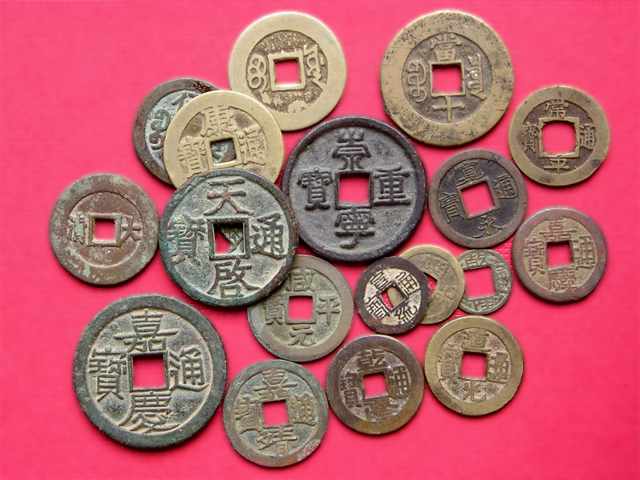
There are coins that look like money.
And then there are coins that look like they have been quietly doing the same job for about two thousand years.
The Chinese cash coin belongs in the second category.
Round.
Usually copper or copper alloy.
A square hole in the middle.
A few Chinese characters.
At first glance, it looks almost comically simple.
But that little hole is the beginning of a rabbit hole.
Because Chinese cash coins are not merely an unusual coin design. They represent one of the longest-running traditions in monetary history — a system that survived dynasties, political fragmentation, economic changes, technological developments and eventually the arrival of modern machine-made coinage.
The National Museum of China describes round coins with square central holes as a form used for roughly two thousand years, while the Shanghai Museum notes that cast copper-alloy coins remained a predominant form of Chinese currency for more than two millennia.
That is an absurdly long time for a design to remain useful.
And it raises a wonderful question:
Why this shape?
Before the cash coin, China was already experimenting
The story does not begin with the famous round coin.
Ancient Chinese monetary culture was remarkably diverse.
Before the Qin unification, different regions and states used different forms of money, including coins shaped like knives and spades, as well as other objects associated with earlier exchange systems. The Shanghai Museum's numismatic collection documents this remarkable variety of pre-Qin forms.
In other words, there was no eternal rule saying:
“All respectable money must be round with a square hole.”
That came later.
The shape was an evolution.
And evolution is usually more interesting than invention.
Then Qin unified China
The great turning point came with the Qin unification in the third century BCE.
The Qin dynasty standardised the monetary system around the Ban Liang coin, a round coin with a central square hole. The Shanghai Museum identifies the Ban Liang as the legal tender following Qin unification and describes the round-square form as the classical shape of Chinese coinage thereafter.
Suddenly, a coin design was doing something much bigger than facilitating payment.
It was helping standardise an empire.
That distinction matters.
Money is one of the easiest ways for a government to turn political unity into everyday experience.
You can announce that the empire is unified.
Or you can make everyone use the same money.
The second option gets into people's pockets.
Why is it round?
This is where things become delightfully philosophical.
Traditional Chinese cosmological symbolism associated the round shape with heaven and the square with earth. The famous “round heaven, square earth” concept is often connected with interpretations of the round outer form and square central opening.
But there is an important methodological point here.
Collectors should be careful about treating symbolic explanations as the only explanation for a practical design.
Coins are engineered objects.
The square hole had an extremely useful practical function: it allowed coins to be threaded onto strings.
The Academy of Chinese Studies notes that the standard Chinese form was a round copper or copper-alloy coin with a square hole, and that coins were generally strung together for transportation.
So the hole was not just philosophical.
It was useful.
Very useful.
And that is one of the great lessons of historical objects:
people rarely build things for only one reason.
A design can be practical, symbolic, political and aesthetic at the same time.
The hole is actually the star of the show
Modern collectors sometimes look at the central hole as an amusing curiosity.
It is anything but.
Imagine having a pile of hundreds or thousands of small coins with no convenient way to organise them.
Now put a hole through the middle.
Suddenly you can string them together.
Money becomes portable.
It becomes countable.
It becomes easier to bundle.
It can be carried over the shoulder, stored in groups and handled in quantities.
The coin was small because individual transactions needed small units.
The string solved the problem of scale.
That is elegant design.
A tiny object becomes a monetary system when you figure out how to move thousands of them.
And then the characters start talking
Turn over a Chinese cash coin and you may find four characters.
These are not random decorations.
They can identify the reign, monetary type or other information depending on the period and series.
For collectors, this is where the coin stops being a generic “Chinese cash coin” and starts becoming a specific historical object.
The characters can reveal the dynasty or reign era associated with the issue.
Suddenly you are not holding:
an old Chinese coin.
You are holding:
a monetary object produced under a particular political regime, in a particular monetary tradition, with a particular inscription.
That difference is enormous.
It is also why Chinese cash coins reward patience.
You cannot simply look at the coin and decide that the characters are “some Chinese writing.”
The characters are the identification system.
Learn them, and the coins start opening up.
The fascinating part: the design barely needed to change
The National Museum of China describes round coins with square holes as being used across roughly two thousand years.
Think about that.
Two thousand years is long enough for languages to change.
Dynasties to collapse.
Religions to spread.
Borders to move.
Technologies to transform.
Yet the basic coin shape remained recognisable.
This is one of the strongest arguments for studying monetary history through objects rather than only through political timelines.
A dynasty might last a few centuries.
A design tradition can last much longer.
The coin becomes the survivor.
But “cash coin” does not mean “one identical coin”
This is where beginners can get themselves into trouble.
Chinese cash coins form a gigantic family, not a single type.
Different dynasties used different inscriptions.
Different reigns produced different issues.
Different materials were used.
Different mints existed.
There were variations in size, weight, calligraphy, manufacturing quality and casting technique.
The National Museum of China's collections show the enormous diversity within the tradition, including coins produced by different regimes and in different scripts.
So if somebody says:
“Chinese cash coins are all the same.”
The correct response is a gentle but firm:
Absolutely not.
They just happen to share a remarkably persistent family resemblance.
And that is much more interesting.
Casting thousands of coins at once
Another reason Chinese cash coins are fascinating is their manufacturing technology.
For much of their history, these coins were cast, rather than individually struck in the manner familiar from many Western coinages.
That changes how you should think about the object.
Instead of imagining a worker placing a blank between two dies and hitting it, imagine a production system designed around moulds and repeated casting.
The Shanghai Museum explicitly identifies cast copper-alloy coins as a dominant form of Chinese currency for more than two thousand years and discusses the development of coin-minting technology alongside increasing demand.
This is not merely a technical curiosity.
Manufacturing determines what kinds of variations collectors will encounter.
It affects surfaces.
Edges.
Casting seams.
Metal flow.
Shape.
Characters.
Production flaws.
And, consequently, authenticity.
The manufacturing method is part of the coin's biography.
Coins and the machinery of the state
The Chinese cash coin also tells a larger political story.
During the Han dynasty, for example, the standardisation and central control of coinage became increasingly important to the state. The Shanghai Museum notes that under Emperor Wu, the Wuzhu coin became the principal currency and that minting and issuance were confined to the central government, helping strengthen financial control and facilitate taxation and commerce.
Read that again.
A coin is helping a government collect taxes.
That means monetary history is not merely economic history.
It is administrative history.
If the state can control the currency, it can influence how people pay taxes, receive salaries, conduct trade and move value.
The humble cash coin was therefore part of the machinery of government.
It was bureaucratic infrastructure disguised as pocket change.
And then China exported the idea
The influence did not stop at China's borders.
The Academy of Chinese Studies notes that from the Sui and Tang periods onward, Korea, Japan and other East Asian states modelled their currency on Chinese forms or used Chinese monetary models, while Chinese coinage influenced neighbouring regions for centuries.
This is one of the great underappreciated stories of Chinese numismatics.
The cash coin is not merely a Chinese object.
It became part of a broader East Asian monetary vocabulary.
Once again, a small object travels farther than its creators might expect.
The cash coin eventually meets modernity
For all its remarkable longevity, the traditional cash coin was not immortal.
By the late Qing period, China increasingly moved toward machine-made coinage.
The Shanghai Museum describes the gradual replacement of traditional square-holed cash coins by machine-made coins during the late Guangxu period, including new copper issues beginning in the early twentieth century.
This transition is fascinating because it marks the moment when an ancient monetary technology finally collides with industrial modernity.
For more than two thousand years, the basic idea had worked.
Then machines arrived.
Modern coinage demanded different standards of production, different denominations and different relationships with an increasingly global monetary economy.
The old cash coin had not suddenly become a “bad design.”
The world around it had changed.
What should a collector actually study?
If you are beginning with Chinese cash coins, resist the temptation to collect only by appearance.
Start with identification.
1. Read the inscription
The characters are your primary clue.
Learn to recognise common reign titles and monetary inscriptions.
This is the difference between looking at the coin and actually reading it.
2. Identify the dynasty and reign
A coin issued during one reign may look remarkably similar to one issued centuries later.
The inscription is what separates them.
3. Study the calligraphy
This is where Chinese cash coins become unexpectedly artistic.
The characters are not simply information.
They are design.
Different scripts and styles can reveal political and cultural context, while variations in calligraphy can help distinguish issues.
The National Museum of China specifically highlights the relationship between Chinese coinage and calligraphic art.
4. Examine the casting
Look at the surfaces.
The edges.
The hole.
The character relief.
The overall fabric.
The production method leaves fingerprints.
5. Learn the mint marks
Once you move beyond beginner material, mint identification becomes enormously useful.
It can transform an apparently common coin into a more specific and potentially much scarcer issue.
The emotional punch of the cash coin
Here is why these coins are so addictive.
A Chinese cash coin is tiny.
Ridiculously tiny compared with the civilisation it represents.
Yet that little disc may have been handled in a market during a dynasty that vanished centuries ago.
It may have paid a tax.
Bought food.
Paid a craftsman.
Been strung with hundreds of others.
Been dropped.
Buried.
Recovered.
Passed into another collection.
And eventually ended up in your hand.
That is the strange intimacy of numismatics.
You are holding something that participated in ordinary life.
Not the throne room.
Not the battlefield.
Not the imperial portrait gallery.
The marketplace.
The street.
The shop.
The tax office.
The traveller's bag.
The worker's payment.
History usually remembers the people at the top.
Coins remember the people underneath them.
And that square hole?
That little hole is almost a metaphor.
It makes the coin lighter.
It makes it easier to string.
It creates a recognisable visual identity.
It reflects an older cosmological idea.
And it has survived for centuries because it worked.
That last part may be the most important.
The Chinese cash coin did not survive merely because tradition said it should.
It survived because tradition and utility happened to agree.
For over two thousand years, the same basic visual grammar kept proving useful.
Round outside.
Square inside.
Characters on the face.
Metal in the hand.
A civilisation's economy moving through a hole in the middle.
And suddenly the “old Chinese coin” sitting in a collector's tray stops looking simple.
It starts looking like one of the most durable pieces of monetary design in human history.