The French Franc
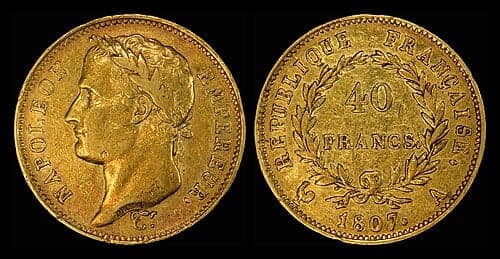
There are coins that simply tell you what they are.
And then there are coins that tell you what an entire country was trying to become.
The French franc belongs firmly in the second category.
At first glance, the franc looks almost aggressively ordinary. A denomination. A number. A portrait. Some lettering. A little bit of metal pressed into a disc.
But spend a little time with French francs and the coin starts behaving less like money and more like a historical timeline.
Because the franc survived kings, revolutions, republics, emperors, wars, economic crises and political reinventions. Its designs changed because France changed. Its metal standards changed because governments changed their ideas about money. Even the word franc itself carries a political story.
And this is where collecting French francs gets interesting.
You are not really collecting one coin.
You are collecting France arguing with itself.
The franc did not begin with Napoleon
This is one of the easiest things to get wrong.
When people hear “French franc,” Napoleon usually barges into the room wearing the most expensive historical costume available.
But the word franc predates Napoleon by several centuries.
The first appearance of the franc as a coin came in 1360, when King John II of France — John the Good — was captured by the English during the Hundred Years' War. A gold coin known as the franc à cheval was created in connection with his ransom.
The Banque de France describes the choice of the word “franc” as a political gesture tied to the need for national affirmation during the Hundred Years' War.
That is a rather wonderful beginning for a currency.
The franc was born not merely because somebody needed another denomination.
It was born at a moment when France desperately needed to say something about France.
And that theme would return again and again.
Then came the Revolution
By the late eighteenth century, France's monetary system was a mess.
The French Revolution had not merely changed the government. It had disrupted the institutions underneath it, including the financial system.
The old monetary order was being dismantled while the new republic was trying to finance itself.
Paper money was introduced. Confidence became fragile. Inflation became a problem. France needed a monetary system that people could actually trust.
And this is where the modern franc enters the story.
The revolutionary government adopted the franc as part of the decimal monetary system in the 1790s. But the really important chapter came a few years later.
Because Napoleon understood something that is easy to forget when looking at coins through a glass case:
money is infrastructure.
You cannot have a functioning economy if nobody trusts the measuring stick.
Imagine trying to buy a house when the ruler changes length every Tuesday.
That is roughly what monetary instability does.
The solution was not simply to put a new portrait on a coin.
France needed a system.
The Germinal franc: turning money into a measuring instrument
In 1803, under the Consulate, France introduced what became known as the franc germinal.
The reform established a bimetallic monetary system based on gold and silver. A one-franc coin was defined around five grams of silver, giving the denomination a fixed metallic basis.
The Monnaie de Paris describes the Germinal franc as a major attempt to restore confidence in French money after years of financial and political turmoil.
And this is the part that makes the franc fascinating.
The important thing was not merely the coin's appearance.
It was the relationship between denomination and metal.
A franc was supposed to mean something measurable.
The state was essentially saying:
Here is the unit.
Here is what the unit represents.
Now go conduct your business.
That sounds painfully boring.
It is also one of the foundations of modern economic life.
The coin becomes a political billboard
Napoleon, of course, was not going to waste such an opportunity.
Coins were among the most efficient pieces of propaganda ever invented because they travelled without needing newspapers.
A newspaper requires literacy.
A speech requires an audience.
A painting requires somebody to stand in front of it.
A coin?
The coin walks away.
It passes from merchant to farmer, soldier to shopkeeper, tax collector to traveller. It enters pockets, tills, markets and households.
And every time someone spends it, they handle the image chosen by the state.
The Monnaie de Paris explicitly notes that Napoleon used coins and medals as powerful vehicles for communication and the construction of his public image.
That makes the French franc particularly fun to collect.
Look closely at the portrait.
You are not simply looking at Napoleon.
You are looking at a government deciding how Napoleon should look.
There is a difference.
A portrait can tell you what the government wants you to believe
Early Napoleonic coinage plays with the visual language of power.
The portrait is carefully controlled. The style evokes the monumental tradition of ancient rulers. The inscription tells you who is issuing the coin and, depending on the period, what political identity the issuer is claiming.
Republic.
Consulate.
Empire.
Restoration.
Republic again.
The same country could change political identity several times while continuing to use the franc.
That is where numismatics becomes almost ridiculously useful as a historical tool.
A textbook might tell you that France changed from one regime to another.
A collection of francs can show you.
You can literally watch the political vocabulary change from coin to coin.
And then there is the famous Napoleon
Collectors often use “Napoleon” to describe French gold 20-franc pieces associated with the Napoleonic monetary system.
But here is another important lesson:
a coin's nickname can be more complicated than its history.
The 20-franc gold piece became one of the great French monetary standards of the nineteenth century, and later rulers continued to use the technical framework established by the Germinal system.
The Monnaie de Paris notes that the famous 20-franc gold “Napoleon” complemented the silver 1- and 5-franc denominations of the Germinal system.
And that means a collector can hold a coin that looks unmistakably “Napoleonic” even when the man himself has long since disappeared from the political stage.
That is not an accident.
It is the power of monetary continuity.
The franc outlived the man
Napoleon died in 1821.
The franc did not.
This is perhaps the most interesting thing about the whole story.
Currencies often survive their creators because the economic system has become bigger than the political figure who helped establish it.
France continued through the Restoration.
Then the July Monarchy.
Then the Second Republic.
Then the Second Empire.
Then the Third Republic.
The franc kept going.
Its portraits changed.
Its symbolism changed.
Its inscriptions changed.
But the monetary unit remained recognisable.
The coin became a kind of political palimpsest — one layer written over another.
Scratch through the portrait and you find a different France underneath.
The franc was also an international story
A good currency does not stay politely inside its borders.
The Germinal monetary system became influential beyond France and served as an important European monetary reference for decades. The Monnaie de Paris describes it as a reference currency in Europe until the early twentieth century, with the system's influence extending well beyond the period of Napoleon himself.
This is important because it changes how we should think about the franc.
It was not simply “French money.”
It was part of the nineteenth-century argument about what a modern monetary system should look like.
Gold and silver.
Fixed relationships.
Standardised denominations.
Predictable weights.
Reliable coinage.
These sound like technical details.
They are actually civilization's plumbing.
And civilization tends to notice plumbing only when it stops working.
So what should a collector look for?
This is where the French franc becomes especially rewarding.
Do not start by asking:
“Is this coin valuable?”
Start by asking:
“What is this coin telling me?”
Then work outward.
1. Identify the political regime
Who is depicted?
What title do they use?
Is the coin Republican, royal, imperial or something else?
The political identity is often the first major clue.
2. Examine the denomination
A 1-franc coin and a 20-franc gold coin may belong to the same broader monetary system, but they operated at very different levels of everyday economic life.
Denomination tells you something about intended use.
3. Look at the metal
Gold and silver were not decorative choices.
They were integral to the monetary system.
The Germinal system was explicitly built around gold and silver standards, so metal content is part of the coin's identity rather than an afterthought.
4. Study the mint marks and dates
This is where the coin stops being a generic historical object and becomes a specific historical object.
A date tells you when.
A mint mark can tell you where.
The combination can tell you which production centre made the object in your hand.
5. Do not ignore condition
History tells you what a coin is.
Condition tells you how much of its physical history remains visible.
A heavily worn franc may have passed through thousands of hands.
A sharply preserved example may preserve details that disappeared from millions of circulating pieces.
Neither is automatically “better” as a historical object.
They simply tell different stories.
The strange emotional power of the franc
There is something slightly intoxicating about holding a French franc.
Partly because the coin is so compact.
A political revolution happened.
An empire rose.
An emperor fell.
France rebuilt itself.
Europe changed.
Industrialisation transformed daily life.
Two world wars came and went.
And through all of this, people continued to carry little discs of metal.
That is the catharsis of numismatics.
History is usually taught as enormous.
Kings.
Wars.
Revolutions.
Borders.
Treaties.
But coins shrink history down to pocket size.
You can hold it.
Turn it over.
Read the inscription.
See the face.
Measure the edge.
And suddenly “Napoleonic France” stops being an abstract phrase.
It becomes something that somebody once accepted in exchange for bread.
Or carried to a market.
Or put aside as savings.
Or lost.
Or found decades later.
The real lesson of the French franc
The French franc is often introduced as a denomination.
That undersells it horribly.
It is better understood as a monetary language that France repeatedly rewrote while retaining enough of the old vocabulary to remain recognisable.
Its history moves from medieval monarchy to revolutionary France, from revolutionary instability to the carefully engineered Germinal system, from Napoleon to later regimes that inherited and modified the monetary framework.
And that is why the franc deserves more than a catalogue entry.
Because every French franc is asking a historical question:
What did France believe money was supposed to do?
Was it supposed to embody sovereignty?
Stabilise commerce?
Represent political legitimacy?
Carry the face of a ruler?
Express republican ideals?
Or simply survive long enough to be useful?
The answer changed.
The coin changed with it.
And that is exactly why collecting French francs is so much more interesting than collecting “old French coins.”
You are not just assembling denominations.
You are watching a country repeatedly redesign itself — one little piece of metal at a time.