The Islamic Gold Dinar
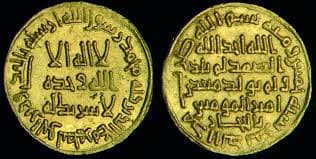
Few coins announce a change in civilisation quite as clearly as the early Islamic gold dinar.
It is small.
It is thin.
It is gold.
And, at first glance, it seems almost aggressively restrained.
There is no emperor standing dramatically on horseback.
No crowned ruler staring heroically into eternity.
No elaborate royal portrait.
Instead, there is writing.
Lines of Arabic.
Religious declarations.
Dates.
Texts arranged with extraordinary confidence around a small piece of gold.
And that is precisely the point.
The early Islamic dinar was not merely a replacement for an older coin.
It represented a decision about what Islamic money should say.
And in 696–697 CE, during the reign of the Umayyad caliph 'Abd al-Malik, that decision became one of the most consequential transformations in the history of Islamic coinage.
The British Museum identifies a gold dinar of 'Abd al-Malik dated AH 77 / 696–697, struck at Damascus, weighing about 4.25 grams and measuring roughly 20 millimetres.
Twenty millimetres.
That is smaller than the story it carries.
Before the Islamic dinar looked Islamic
This is where the story gets interesting immediately.
The first generations of Islamic coinage did not suddenly emerge with a completely new visual language.
The early Muslim states inherited an enormous monetary world.
Byzantine gold coins circulated widely.
Sasanian silver coinage was influential in the east.
The new Islamic territories did not exist in some economic vacuum where everybody politely waited for a brand-new Islamic coin to be invented.
People needed money.
And they already had money.
So early Islamic rulers adapted existing monetary traditions.
That is why some early Arab-Byzantine coins can look surprisingly Byzantine.
The British Museum, for example, preserves a gold dinar of 'Abd al-Malik from 695 CE that still uses a figurative design derived from Byzantine prototypes, including a standing ruler and a modified cross motif.
And then something changes.
The great reform
Under 'Abd al-Malik, the Umayyad caliphate underwent a major monetary reform.
The British Museum notes that after the political consolidation of the caliphate, 'Abd al-Malik introduced coinage reforms, promoted Arabic as the official administrative language and replaced Greek and Middle Persian inscriptions with Arabic inscriptions including Qur'anic verses.
This is the moment when the dinar becomes truly fascinating.
Because the question is no longer:
“How much gold is this?”
It becomes:
“What does an Islamic state want its money to communicate?”
And the answer was increasingly clear.
Not a portrait.
Not a borrowed imperial icon.
Text.
The disappearance of the portrait
The reform dinars of 696–697 CE are famous partly because they abandon the traditional ruler portrait.
The British Museum describes the AH 77 dinar as part of this new imageless coinage.
That may sound like a small artistic decision.
It wasn't.
Coins had spent centuries putting rulers on money.
The portrait told you who had power.
It made sovereignty visible.
It created a face for the state.
Now the face disappears.
In its place comes Arabic calligraphy.
This is not simply an aesthetic makeover.
It is a new monetary language.
A coin that reads instead of looks
Hold an early Islamic dinar beside a Byzantine gold coin and the contrast is striking.
The Byzantine coin wants you to recognise a ruler.
The reformed Islamic dinar asks you to read.
The centre of the coin becomes a textual field.
The border becomes another textual field.
The coin is now carrying religious and political information through language.
That makes the early Islamic dinar one of the great examples of an important numismatic principle:
what a coin refuses to show can be just as important as what it shows.
The absence of a portrait is itself a statement.
Why gold?
Gold was not chosen because somebody thought shiny things were nice.
Gold was the high-value monetary metal of the Mediterranean and Near Eastern monetary world, with deep roots in Byzantine and earlier traditions.
The Islamic dinar therefore entered an existing international ecosystem of precious-metal money.
That matters because monetary reform is not performed on a blank canvas.
If you issue a gold coin, merchants immediately want to know:
How much gold?
What standard?
Will people accept it?
Can it travel?
Will another market recognise it?
The physical specifications matter enormously.
The British Museum example from AH 77 is approximately 20 millimetres in diameter and weighs 4.25 grams.
That tiny object was designed to function within a much larger commercial world.
The Arabic inscription is the architecture
One of the easiest mistakes a beginner can make is to treat the Arabic on Islamic coins as decoration.
Please don't.
It is the coin.
The calligraphy isn't sitting on top of the object like wallpaper.
It is the architecture around which the object is designed.
The British Museum's description of the AH 77 dinar notes that its inscriptions include the Islamic declaration of faith and that the coin forms part of the transition toward an explicitly Islamic epigraphic design.
The Islamic Art Museum's virtual collection similarly identifies a 77 AH / 697 CE Umayyad gold dinar from Damascus as one of the earliest products of 'Abd al-Malik's monetary reform, with Arabic calligraphy replacing the figurative imagery of earlier prototypes.
So for the collector, learning the inscriptions is not optional decoration.
It is identification.
It is history.
It is theology.
It is political context.
And sometimes it is the difference between understanding the coin and merely owning it.
The date is hiding in plain sight
Islamic coins introduce another fascinating feature for collectors:
the Hijri calendar.
Instead of simply giving a modern-style year, early Islamic coins can identify the year according to the Islamic calendar, using AH dates.
That means the date is not just a number.
It belongs to a different chronological system.
A coin dated AH 77 corresponds to 696–697 CE.
The British Museum's example provides exactly this pairing.
This is another reason Islamic numismatics is so rewarding.
The coin forces you to learn how another civilisation measured historical time.
Suddenly chronology itself becomes part of collecting.
The reform was about more than coins
This is where we need to resist a very tempting simplification.
It would be easy to say:
“'Abd al-Malik changed the coin design.”
True.
But insufficient.
The reform happened alongside broader administrative changes.
The British Museum notes that 'Abd al-Malik promoted Arabic as the official administrative language while reforming the coinage and replacing Greek and Pahlavi inscriptions with Arabic and Qur'anic text.
That means the coins belong to a wider process of state formation.
Language.
Administration.
Religion.
Sovereignty.
Money.
All moving in the same direction.
The coin becomes a miniature expression of a state becoming more internally coherent.
And then the coin travels
Gold has always had an annoying habit of travelling.
Governments can issue it.
Merchants can move it.
Armies can carry it.
Traders can export it.
Wealth can cross borders even when politics becomes extremely territorial.
That makes the Islamic dinar particularly valuable for understanding the connected medieval world.
The Umayyad state was enormous.
Its monetary system existed within networks connecting the Mediterranean, North Africa, the Middle East and beyond.
A gold dinar was therefore not simply a domestic token.
It was an object designed to be trusted across economic relationships.
And trust is the hidden subject of monetary history.
The collector's problem: don't stop at “gold”
This is where modern collecting can sometimes go slightly off the rails.
You see:
GOLD DINAR
Brain says:
GOLD.
Wallet starts sweating.
But the numismatist should immediately ask a much longer list of questions.
Who issued it?
When?
Where?
What is the inscription?
What type?
What weight?
What diameter?
What is the style of calligraphy?
Does the coin fit the known fabric of the issue?
Is the attribution secure?
Is it authentic?
Has it been altered?
Has it been mounted?
Is it a modern reproduction?
Is the apparent rarity real?
This is especially important with ancient and early Islamic coins because historical importance and market value are not identical things.
A famous ruler does not automatically make every coin rare.
A gold coin is not automatically rare.
And an old coin is certainly not automatically valuable.
Numismatics rewards evidence.
How to approach an early Islamic dinar
Start methodically.
1. Identify the ruler
The name of the issuer may or may not appear directly on the coin depending on type.
Do not assume.
Use the inscription and established references.
2. Read the date
Learn the Hijri calendar.
An AH date is a powerful identification tool.
3. Identify the mint
Some issues explicitly identify where they were struck.
Others don't.
The absence of a mint name can itself be characteristic of a particular type.
4. Study the calligraphy
This is one of the most important aspects of Islamic numismatics.
Letter forms, arrangement and style can help distinguish periods and issues.
5. Weigh and measure it
Do not rely on appearance.
Weight and diameter are evidence.
The British Museum's AH 77 example, for instance, weighs 4.25 grams and measures about 20 millimetres.
6. Compare the whole coin
A genuine coin has a relationship between its fabric, weight, strike, inscription, metal and style.
One suspicious detail does not necessarily prove anything.
But several inconsistencies deserve serious attention.
That is why authentication should be approached as a methodology rather than a gut feeling.
The really beautiful part
Here is the thing that makes the Islamic gold dinar so emotionally powerful.
It is a coin from a period when an enormous political and cultural transformation was underway.
And instead of screaming about it, the coin quietly writes it down.
No giant portrait.
No heroic battle scene.
No dramatic imperial pose.
Just text.
A few lines of Arabic on gold.
And yet those lines tell you:
who issued the coin,
what language the state was using,
what religious message it considered appropriate,
when the coin was produced,
and how the Islamic monetary system was separating itself visually from the older Byzantine and Sasanian traditions around it.
That is an extraordinary amount of history to fit into twenty millimetres.
The dinar's real legacy
The early Islamic gold dinar matters because it demonstrates that a coin can be an instrument of political and cultural transformation.
It is money.
But it is also language.
It is theology.
It is administration.
It is sovereignty.
It is technology.
It is international commerce.
And it is memory.
The reform under 'Abd al-Malik did not simply produce a prettier coin.
It helped establish a distinctive Islamic visual and monetary vocabulary, replacing inherited figurative designs with an epigraphic language centred on Arabic inscriptions.
And once you understand that, the coin becomes almost impossible to look at casually.
That little circle of gold is no longer merely an “Islamic gold coin.”
It is evidence of a civilisation deciding how it wanted its money to speak.
And perhaps that is the best way to think about ancient coins in general.
They are not silent objects.
They are just extremely old voices.
You have to learn how to read them.