The Maria Theresa Thaler and the Longevity of Monetary Reputation
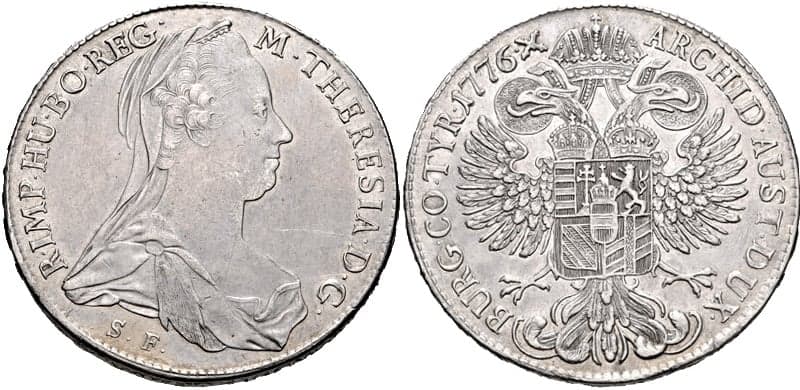
Imagine inventing a currency that refuses to die.
The government that issued it disappears.
The political borders around it change.
The empress whose face appears on it has been dead for centuries.
And yet merchants keep using the coin.
They keep recognising it.
They keep trusting it.
They keep asking for it.
That is the extraordinary story of the Maria Theresa thaler.
It is one of the great oddities of monetary history because it demonstrates something that economists sometimes explain with complicated words but collectors can understand immediately:
reputation can become more valuable than sovereignty.
The coin was associated with Maria Theresa, the Habsburg empress who ruled from 1740 to 1780.
But the most famous form of the coin is dated 1780 — the year Maria Theresa died.
And here's the wonderfully strange part.
The 1780 date kept appearing on restrikes long after her death.
The coin effectively became immortal.
Not because the empress was immortal.
Because the market had decided that 1780 meant something.
A coin that outlived its ruler
Maria Theresa's thaler was a large silver coin first issued in the Habsburg world.
The type became associated with the empress and acquired enormous circulation outside the territories that originally issued it.
The British Museum holds examples of Maria Theresa thalers and documents their use and production history, while the Austrian Mint's own history identifies the 1780-dated type as one of the most enduring products of the Habsburg monetary tradition.
But the key thing to understand is this:
the 1780 date does not necessarily mean the coin was physically struck in 1780.
That is the trap.
Collectors see:
M. THERESIA
and
1780
and instinctively think:
“Ah, a coin from 1780.”
Not necessarily.
The 1780 date became part of the type's identity.
That changes everything.
Why would anyone do that?
Because people trusted the coin.
And trust is sticky.
Suppose you are a merchant.
You receive a silver coin from someone.
You know its weight.
You know its appearance.
You know its silver content.
You have seen other merchants accept it.
You have perhaps used it yourself.
You do not particularly care whether the woman depicted on it has been dead for ten years.
You care whether the next person will accept it.
That is the real engine of monetary circulation.
Not the portrait.
Not the government.
Not even necessarily the legal tender status.
Acceptance.
A coin becomes useful because other people believe other people will accept it.
The Maria Theresa thaler became an extraordinary demonstration of that principle.
The empress became a brand
This is where the coin gets wonderfully weird.
Maria Theresa herself was not physically present in the markets where these later thalers circulated.
But her image remained.
The coin's design became recognisable.
Its specifications became familiar.
Its name acquired meaning.
The empress had effectively become a monetary brand.
And this is one of the most useful ways to understand historical coins.
A coin does not need to be politically sovereign to remain economically useful.
Sometimes the market remembers the object after the state stops mattering.
The 1780 date becomes a trademark
Think about modern trademarks.
If a company discovers that consumers strongly associate a particular symbol with reliability, it does not casually redesign the symbol every Tuesday.
Consistency creates recognition.
The same thing happened with the Maria Theresa thaler.
The continued use of the 1780 date helped preserve the identity of the trusted type.
The coin was no longer communicating:
“I was minted in 1780.”
It was increasingly communicating:
“I am the Maria Theresa thaler you already know.”
That is a completely different function for a date.
It has stopped being merely chronological.
It has become branding.
And that is why the coin is such a beautiful case study in monetary reputation.
But why did people trust it?
Because reputation alone cannot conjure silver out of thin air.
The coin had physical credibility.
It was a substantial silver piece with a familiar weight and appearance.
That mattered.
A merchant could recognise the type.
A moneychanger could evaluate it.
A trader could compare it with known examples.
The coin's reliability was reinforced by its physical standard.
This is a recurring theme in successful historical money:
trust begins as a relationship between people and an object.
If the object repeatedly behaves as expected, confidence accumulates.
Reputation becomes portable
This is the really fascinating bit.
Imagine a merchant travelling through a region where he does not know the local political authorities particularly well.
He sees a Maria Theresa thaler.
He recognises it.
Perhaps the merchant doesn't speak the local language.
Perhaps he has no relationship with the person offering it.
But the coin itself is familiar.
The object carries its own reputation.
That is monetary portability.
And it is why certain coins can travel much farther than their issuing governments ever intended.
Africa and the Middle East become crucial
The Maria Theresa thaler became particularly associated with trade in parts of the Middle East and Africa.
Its reputation persisted well beyond the Habsburg territories.
That is a crucial point.
The coin's geographical history cannot be understood simply by drawing a map of the Habsburg Empire.
The coin travelled through commercial networks.
Merchants made it travel.
Markets made it useful.
And reputation accumulated through repeated acceptance.
This is one of the reasons the thaler is so important for understanding monetary history.
The state issued the object.
But the market decided how far its life would extend.
Legal tender and useful money are not always the same thing
This distinction deserves attention.
Modern people often assume that money is valuable because the government says:
“This is legal tender.”
Historically, things can be much messier.
A coin can circulate because people voluntarily accept it.
A foreign coin can be used because it has a reputation.
A local coin can be rejected because nobody trusts its metal content.
The Maria Theresa thaler demonstrates this beautifully.
Its reputation became a kind of informal monetary authority.
It did not need the same political state behind every transaction.
It needed a network of people who believed the next person would accept it.
The strangest thing about the thaler is its date
For collectors, this creates a fascinating methodological problem.
You cannot look at “1780” and immediately conclude:
“This is a coin from 1780.”
You have to ask:
“What exactly does this 1780 represent?”
That question is incredibly important.
A coin's date can indicate:
the actual year of manufacture; a reign year; a commemorative reference; a frozen historical type; or, in cases like the Maria Theresa thaler, a date deliberately retained across later production.
The number is evidence.
But evidence needs interpretation.
This is one of the fundamental habits of serious numismatics.
Never let one piece of information do the work of five.
How should you study a Maria Theresa thaler?
1. Start with the type
Learn the standard design.
Portrait.
Reverse.
Legend.
Bust.
Heraldic details.
The overall fabric.
2. Examine the mint and production characteristics
Later restrikes can have their own identifiable characteristics.
Do not assume every 1780-dated example is an eighteenth-century original.
3. Check the weight and dimensions
The expected standard provides an important first filter.
A coin that is dramatically wrong in weight deserves questions.
4. Study the surface
Look for evidence of casting, tooling, artificial ageing or other alterations.
But don't diagnose authenticity from a single surface feature.
5. Understand the restrike history
This is essential.
The thaler's historical significance partly comes from the fact that its life continued through repeated production.
So “restrike” is not a footnote.
It is the central story.
A collector's paradox
Here is the wonderful paradox.
The most famous Maria Theresa thaler is famous precisely because it wasn't confined to one historical moment.
Most old coins are valuable to historians partly because they are specific.
This one became powerful partly because it was reproducible.
The original date became detached from the original year.
The coin became a type.
And the type became a reputation.
That is unusual.
And it forces us to rethink what we mean when we call something an “old coin.”
Age is one attribute.
Historical continuity is another.
A coin can be historically important because it is ancient.
But it can also be historically important because people kept making it.
The coin becomes bigger than the empire
This is the deepest lesson of the Maria Theresa thaler.
The Habsburg political system created the coin.
But it did not completely control the coin's historical destiny.
Once the type became trusted, merchants and markets effectively took over.
The coin developed a second life.
Then a third.
Then another.
The state became only one chapter of its biography.
The market wrote the rest.
And that is why monetary reputation is such a powerful thing.
A government can declare a coin valid.
It cannot automatically make people love it.
It cannot automatically make merchants accept it.
It cannot guarantee that strangers hundreds of miles away will trust it.
Those things have to be earned.
The Maria Theresa thaler earned them.
Why collectors should care
Because the thaler teaches one of the most important lessons in numismatics:
a coin's history is not necessarily the same thing as the history of the government that issued it.
You have to follow the object.
Where did it go?
Who used it?
Why was it accepted?
Why was it reproduced?
Why did the market continue to want it?
Those questions often produce a much more interesting history than simply listing rulers and dates.
And they change the way you look at the coin itself.
The portrait of Maria Theresa stops being just the portrait of an empress.
It becomes a logo.
The 1780 date stops being merely a year.
It becomes a brand identifier.
The silver stops being merely metal.
It becomes part of the physical evidence behind a reputation.
And the continued restriking stops being a numismatic nuisance.
It becomes the whole point.
The thaler's final lesson
Political power is usually imagined as something that flows from the top down.
Governments issue money.
People use it.
End of story.
The Maria Theresa thaler complicates that beautifully.
The government issued a coin.
People adopted it.
Markets reinforced its reputation.
The coin travelled.
Its original political context faded.
Its date remained.
And eventually the object became famous for something that no emperor or empress could have completely commanded:
trust after the disappearance of authority.
That is an extraordinary thing.
Maria Theresa died in 1780.
Her empire changed.
Europe changed.
Africa and the Middle East changed.
Global trade changed.
The monetary world changed.
And yet that little silver coin kept appearing.
1780.
Still 1780.
Again.
And again.
And again.
The date became a memory.
The memory became a reputation.
And the reputation became money.
That is why the Maria Theresa thaler is not simply a famous old silver coin.
It is one of the clearest demonstrations in numismatic history that sometimes the most powerful thing a currency can possess is not legal authority.
It is a good name.