The Roman Denarius and the Economics of Imperial Scale
The Roman Empire was enormous.
Not “wow, that's a big country” enormous.
How on earth do you collect taxes, feed armies, pay workers, move goods and keep millions of people economically connected across three continents? enormous.
And somewhere inside that machine was a little silver coin.
The denarius.
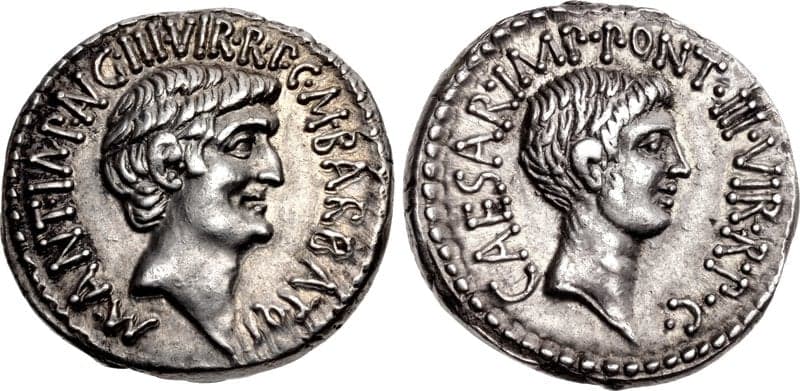
It is easy to look at a Roman denarius and see an ancient silver coin with a famous face on it.
Julius Caesar.
Augustus.
Nero.
Trajan.
Hadrian.
Pick a Roman emperor and chances are there is a coin with his face somewhere.
But the portrait is only the beginning.
The denarius was one of the monetary technologies that allowed Rome to operate at imperial scale.
Not because coins magically created the Roman economy.
They didn't.
But because standardised money made certain forms of taxation, military payment, commerce and accounting dramatically easier.
And once you start looking at the denarius through that lens, Roman history becomes strangely tangible.
The empire stops looking like a map.
It starts looking like a payment network.
The denarius was old before the emperors
The denarius was introduced by the Roman Republic around the late third century BCE, traditionally dated to around 211 BCE.
That is important.
The denarius was not invented by the Roman emperors.
It was inherited by them.
By the time Augustus came to power, the coin already had a long history.
This tells us something fundamental about Roman institutions.
Rome was very good at keeping useful things.
The Republic disappeared.
The denarius remained.
The political system changed.
The monetary system adapted.
The empire could therefore build on an existing monetary vocabulary rather than starting from zero.
Originally, it was silver
The early denarius was a silver coin weighing around four grams, though its exact weight and silver content changed over time.
The coin's relationship to Roman accounting was also important.
The denarius was tied to the broader Roman monetary system in which larger and smaller denominations could be related through established ratios.
This mattered because Roman economic life required more than one denomination.
A soldier's pay.
A loaf of bread.
A tax obligation.
A wholesale shipment of grain.
A luxury purchase.
These transactions operate at very different scales.
The monetary system had to handle all of them.
That is where denomination hierarchies become important.
Money is really an accounting language
This is perhaps the most useful way to think about Roman coinage.
Imagine an empire trying to keep accounts across thousands of kilometres without a common unit.
Every tax assessment becomes harder.
Every military payroll becomes harder.
Every commercial contract becomes harder.
Every government expenditure becomes harder.
The denarius provided a common monetary reference.
But here's the important caveat:
Roman monetary life was not simply “everything was paid in denarii.”
Roman economies used multiple denominations, and local and regional monetary practices varied.
Coins circulated alongside non-monetary forms of exchange.
Prices differed.
Markets differed.
Economic life was messy.
Good.
That is what makes it real.
The army made money move
If you want to understand Roman coinage, follow the army.
Rome's military machine was enormous.
Soldiers had to be paid.
Supplied.
Moved.
Equipped.
Fed.
Rewarded.
And retired.
The denarius therefore became closely associated with military pay.
That created an extraordinary circulation network.
Imagine a coin leaving a mint.
It gets sent to an army.
A soldier receives it.
The soldier spends it in a market.
A merchant uses it to buy supplies.
A supplier pays workers.
Those workers buy food.
The money moves again.
The coin does not need to stay in one place.
It becomes a circulating instruction:
this piece of metal represents value.
That is monetary velocity in ancient clothing.
But Rome needed enormous amounts of money
This is where scale becomes the central problem.
A small city-state can manage money differently from an empire stretching from Britain to Syria and North Africa.
The Roman state therefore needed large-scale minting.
Coins were produced at different mints across the empire, especially as political and military circumstances changed.
The location of mints mattered because money has to physically reach the people who use it.
You cannot pay an army in Britain with coins sitting in a vault in Rome.
Well.
You can.
But you will have a rather unhappy army.
The monetary system therefore had geography.
Coins were also propaganda
Now we arrive at the part everyone notices.
The emperor.
Roman coins are extraordinarily good at making the state visible.
A coin might show the emperor's portrait.
A military victory.
A deity.
A personification.
A building.
A religious symbol.
A political message.
And because coins circulated widely, the imagery travelled with them.
The emperor did not have to personally visit every province.
His face did.
This is one of the great advantages of coins as political communication.
A Roman coin was both money and a tiny broadcast device.
The reverse tells you what the emperor wants remembered
This is why Roman coins are so much fun to study.
The portrait tells you who.
The reverse often tells you why you should care.
Victory?
Peace?
Abundance?
Military strength?
Divine favour?
A new building?
A conquered enemy?
The coin becomes a miniature political headline.
And unlike a modern headline, it can survive for two thousand years.
Julius Caesar changes the rules
One of the most famous developments in Roman coinage came during the late Republic.
Julius Caesar became the first living Roman to be depicted on a coin issued in his own lifetime.
That was a big deal.
Roman Republican coinage traditionally featured gods, personifications and historical figures rather than routinely putting living political leaders on the circulating coinage.
Caesar broke that convention.
And then the political world changed.
After his assassination, the use of ruler portraits became central to imperial coinage.
The coin had become inseparable from the personality of the state.
That is an extraordinary transformation.
Augustus understands the power of the coin
Augustus inherited a world in which political legitimacy needed to be rebuilt after civil war.
Coins became one of the tools through which the new regime communicated itself.
His coinage presented military achievements, religious restoration, political stability and imperial legitimacy.
Again, the coin is not merely recording history.
It is participating in it.
A collector looking at an Augustan denarius should therefore ask:
What is this coin trying to make me believe?
That question is much more interesting than:
What is this emperor's name?
The denarius also tells us about inflation
Here the story gets uncomfortable.
The denarius did not remain chemically identical forever.
Over centuries, Roman rulers repeatedly altered the weight and silver content of silver coinage.
One of the most important transformations came under Nero, who reduced the weight and fineness of the denarius.
Later emperors continued modifying the monetary system.
Under Caracalla, the empire introduced the antoninianus, a larger-looking silver denomination that was initially tariffed at two denarii but contained significantly less than twice the silver of two denarii.
That is monetary engineering doing something very familiar.
Governments can change the relationship between the nominal value of money and the material from which it is made.
And once that relationship changes, people notice.
The problem with “debasement”
Modern collectors sometimes talk about Roman coinage as if every reduction in silver content was simply an act of incompetence.
That is too simple.
Debasement can reflect fiscal pressure.
Military expenditure.
Political instability.
Changes in the supply of precious metals.
Attempts to increase the quantity of coinage available.
Emergency financing.
Or broader transformations in the monetary system.
The important point is that the metal content of a coin is evidence of the economic environment in which it was produced.
A denarius from Augustus and one from later imperial periods may carry the same denomination but represent very different monetary realities.
This is why weight matters
A Roman coin should never be identified solely by its appearance.
Weight is crucial.
Diameter matters.
Metal matters.
Die style matters.
Portrait style matters.
Legend matters.
Mint attribution matters.
And the relationship between all of those features matters even more.
This is especially important because ancient coins are heavily collected and heavily reproduced.
A convincing-looking fake can fool someone who knows the emperor but does not know the fabric.
Numismatics is not a guessing game.
It is comparative analysis.
How to study a Roman denarius
1. Read the legend
The legend can identify the emperor, title, office and sometimes other political information.
Abbreviations are everywhere.
Learn them.
2. Study the portrait
Portrait style changes over time.
Hair.
Beard.
Facial proportions.
Laurel wreath.
Bust type.
These details can help narrow attribution.
3. Read the reverse
What is happening?
A deity?
A military figure?
A personification?
A building?
A trophy?
The reverse is often a political message.
4. Identify the mint
Mint attribution can be difficult for some issues, but when available it adds another layer of historical geography.
5. Weigh it
A coin's expected weight range is evidence.
Not proof by itself.
Evidence.
6. Examine the metal
Silver composition and surface characteristics can tell you more than a photograph often can.
7. Study the edges
Ancient coins have distinctive production characteristics.
Edges can be extremely useful in authentication.
The point is not to memorise one magical “fake detector.”
The point is to build a case from multiple independent observations.
The denarius connects the emperor to the ordinary person
This is perhaps the most emotionally powerful part.
The Roman emperor is one of the largest figures in ancient history.
The denarius is one of the smallest.
Yet the two are directly connected.
The emperor's portrait is placed on the coin.
The coin enters circulation.
A soldier receives it.
A merchant handles it.
A farmer receives it.
A tax collector counts it.
A craftsman spends it.
Someone loses it.
Someone buries it.
Two thousand years later, someone digs it out of the ground.
That is an astonishing chain.
The coin is a physical survivor of ordinary economic life.
The emperor wanted immortality.
The coin accidentally provided it.
But the denarius did not make Rome
This distinction matters.
It would be absurd to say:
“Rome became an empire because of the denarius.”
No.
Military power, agriculture, taxation, institutions, slavery, trade networks, geography, political organisation and countless other factors mattered.
The denarius was infrastructure within that system.
Infrastructure rarely gets the heroic credit.
Nobody writes epic poems about accounting.
But empires cannot survive on epic poems.
They need payroll.
They need procurement.
They need tax collection.
They need markets.
They need units of account.
They need trust.
The denarius was part of that machinery.
And eventually the denarius fades
The denomination did not survive unchanged throughout Roman monetary history.
As the monetary system evolved, new denominations became more important.
By late antiquity, the denarius as a physical silver coin had effectively disappeared as the dominant form of Roman silver currency.
But its accounting legacy survived.
The Roman monetary system had evolved far beyond the original Republican coin.
Again, the lesson is that currencies have biographies.
Birth.
Growth.
Transformation.
Decline.
Replacement.
And sometimes ghosts.
The real lesson of the denarius
The denarius is often introduced as:
“the standard Roman silver coin.”
Fine.
But that description is like calling a railway “some metal tracks.”
Technically accurate.
Completely inadequate.
The denarius was part of a monetary network that helped Rome coordinate value across enormous distances.
It connected soldiers and merchants.
Taxpayers and administrators.
Mints and markets.
Emperors and ordinary people.
It also recorded political messages, changes in imperial ideology and the fiscal pressures that transformed Roman money over centuries.
And this is why a denarius deserves to be studied as more than an ancient silver object.
It is a piece of infrastructure.
A tiny one.
Four grams or so of metal.
But infrastructure nonetheless.
Because empires do not operate at scale through ambition alone.
They need systems that make millions of small transactions possible.
The Roman denarius was one of those systems.
And perhaps that is the great numismatic joke.
Rome built roads across continents.
It built aqueducts.
It built fortresses.
It built cities.
It built an administrative machine of astonishing complexity.
And somewhere in the middle of all that grandeur, people were still standing in markets arguing over the price of bread.
A denarius passed from one hand to another.
Then another.
Then another.
The empire was enormous.
The coin was tiny.
And somehow, the tiny thing helps explain how the enormous thing worked.